




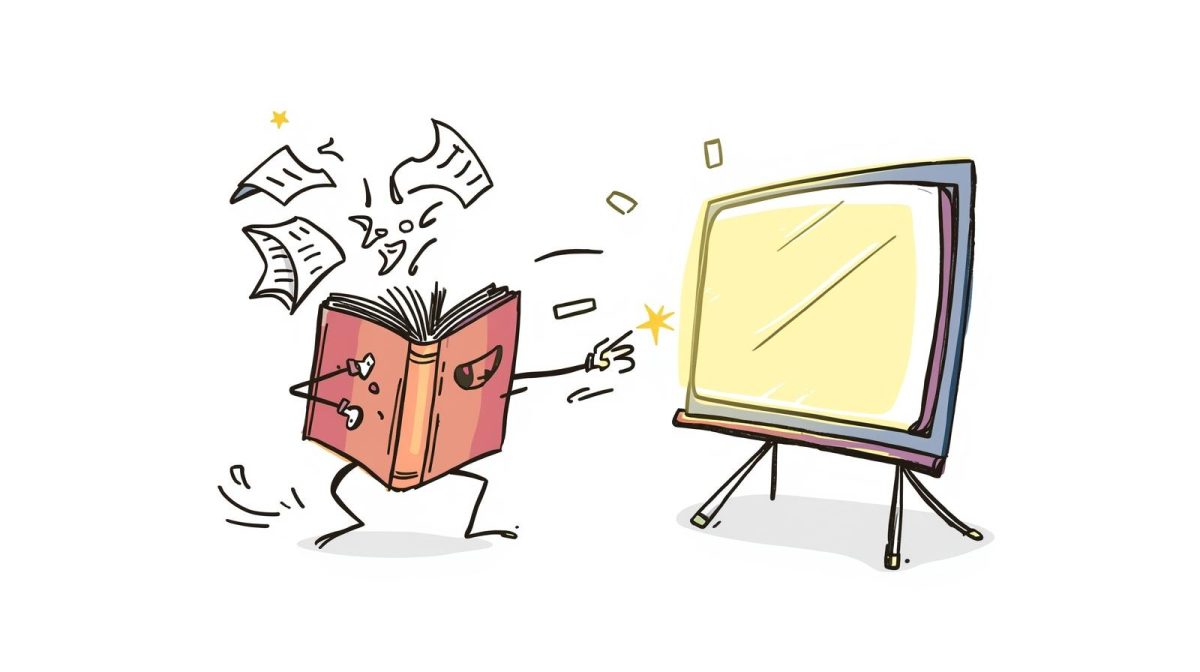
Picture this: a movie theatre full of people who anxiously awaited the release of this latest flick. This is no ordinary flick; it is a movie adaptation. Finally, what once were just words are now moving pictures. I am a firm believer that movies are better than their literary counterparts. Don’t get me wrong, reading, especially for young people, is very important. Movies are often better than book versions because they bring stories to life in vivid and visual ways that words alone can’t achieve. Through acting, music, and cinematography, movies create an immersive experience.
Nothing in my mind is more boring than a book that drones on and on. If I’m reading a story, I want the story. The movie versions condense complex plots of novels into more fast-paced narratives. While reading The Seven Husbands of Evelyn Hugo, I constantly thought to myself, “This is a great book, but it would be so good on screen.” The Instagram announcement popped up on my phone a year later: “Taylor Jenkins Reid hit novel to become a Netflix film.”
There was no cast list, but that didn’t matter. Hopes for the movie adaptations are also what make the experience so fun. Fans enjoy discussing which actors best match a character’s looks, personality, and energy. This turns anticipation into debates and trends, which in turn brings people together. It’s exciting to picture how an actor might interpret a character’s emotions or iconic quotes. There is a big difference between visualizing your favorite characters in your mind and seeing them on screen.
When reading a book, listening to music alongside the words can confuse you and throw you off the comprehension train. In movies, all of the wonderfulness of the plot blends perfectly together with the soundtrack. Take Regretting You for instance. Songs like “Everywhere, Everything” by Noah Khan and Gracie Abrams and “Writing on the Wall” by ROLE MODEL encapsulate scenes. This makes the story feel lived in.
Granted, sometimes directors have to make tough decisions. Not every book can be translated to the screen word-for-word. Some will say that movies or TV shows do not always accurately portray them, but I have yet to see an actor who wasn’t well cast. In fact, I have yet to watch a movie version of a book that has not exceeded my expectations.
As the seasons start to change, it becomes the perfect time to curl up under the covers with a hot beverage and a good read. I’ve always believed that books are better than their on-screen counterparts. While I appreciate how movie adaptations can offer new fans an easy introduction to a standalone or series, I’d much rather experience all of a story. Every word that’s been printed has a meaning that movies simply cannot convey to the fullest. Books teach us to appreciate the little things and help us expand our imaginations.
The average book takes 6-15 hours to finish in one sitting, depending on the reader’s speed, focus, and interest. The average movie is 90-120 minutes long. Just imagine how many scenes are cut out to slim down books into feature film length. So many things are left unsaid for the sake of a time cap! But when you actually have the words in front of you, you start to read between the lines. Those “insignificant” scenes that are omitted from adaptations help the reader to resonate with the story more and develop characters.
While I love seeing stories brought to life through cinematography, I also think it’s important to interpret a story on your own. Reading allows you to create your own version of settings and characters. For this reason, books are as or more immersive than movies. If you’re anything like me, then you can get lost in a good book for hours. You become engrossed in that ideal version of the story. Like a fingerprint, every interpretation is different, and movies simply cannot replicate that individuality while catering to every single person. It’s quite the rude awakening to see a beloved book adapted on screen and realize the filmmakers’ vision is nothing like the world you conjured up in your dreams.
Books are also much more accessible. Not everyone can afford to buy a movie from a streaming service—let alone subscribe to a platform in the first place—and some can’t even spare the cost of a movie-theatre ticket. And as academic life becomes more rigorous, time to sit down and watch a movie becomes scarce, meaning rented movies will expire before there’s time to finish the flick. There are many public domain .pngs of books circulating online, or you can go to a public library to read on site without having to pay for a library card.
But the point of this isn’t to make you hate movies. To tell the truth, I don’t think I’ve ever watched a movie adaptation of a book that I haven’t thoroughly enjoyed. I only ask that you don’t limit yourself to what is shown on screen, and instead also take the time to experience and appreciate the creative process of reading.